
Wow – how is it August already! What a year we have all lived through on so many fronts and we haven’t even had our local elections yet….
Before we share some of our thoughts, we would like to provide some GDA family news:
- Wesley Junor has come on as a co-owner and key-individual of our business 😊. Over the last 3 years he has grown to be a trusted advisor to many of our clients and an integral part of our team. As a fellow CA(SA) and over 8 years in the financial advising space, he brings a wealth of knowledge. We are excited to have him on the leadership team and help shape the future of GDA.
- At the end of September, we will be celebrating the one and only David Geach’s 70th birthday! It is and continues to be a real privilege to work alongside a man of such integrity, strong work ethic, care for others and skill. My only frustration is working with 2 guys that look so very much younger than their age.
- We would like to congratulate Debbie on achieving excellent results in her Higher Certificate in Wealth Management. Our Forex division continues to grow in leaps and bounds.
- In July we said a sad farewell to Denelle who has returned to working in the Energy sector with opportunity to travel. We will miss her quiet but lovely temperament and thank her for all serving us and our client so diligently.
- Kendall Geach has jumped in to assist our very capable team of Terry and Annette with some of the back-office admin. It has been a joy to have her in office.
Now to some Investment thoughts:
The Good
After years of very little change the annual budget speech provided some welcome tax relief for the 2026/2027 tax year
There are a few genuinely positive changes coming into effect from 1 March 2026 — mainly in the form of higher tax-free thresholds and contribution limits.
- Tax-free investments: Up from R36,000 to R46,000. Annoyingly, this is a monthly debit order amount of R3,833.33, but if you can make the full contribution upfront as a lumpsum, you will enjoy the tax free compounding earlier than if you did the monthly debit order.
- Annual Retirement contributions (deductible): Up from R350,000 to R430,000
- CGT annual exclusion: Up from R40,000 to R50,000 annual exemption, and CGT relief on death up from R300,000 to R440,000
- Primary residence exclusion: Increased to R3 million (up from R2 million), another welcome inflationary adjustment
- Donations Tax thresholds: Increased from R100K per year to R150K per year
- Income bracket adjustments: Income brackets were adjusted for inflation, to ensure that salary increases won’t push individuals into higher tax brackets. Further, annual rebates and medical rebates were increased slightly.
On the business side, the standout change:
- VAT & micro business thresholds jump from R1m to R2.3m. The last time the thresholds were updated was in 2009, so this is a welcome adjustment for smaller businesses that were breaching the R1m turnover threshold.
This gives small businesses more room to grow before facing added compliance and admin.
Another change that is really helpful is the Single Discretionary Allowance increase from R1 million per calendar year, to R2 million. This allows an individual to transfer money offshore with no SARS clearance needed in a simple and efficient manner.
Should you need assistance with your foreign exchange, you are welcome to contact Debbie in our office at debbie@gda.co.za or fx@gda.co.za.
The Bad
Markets were flying at the start of the year. The base case predictions for interest rates for South Africa were for 3 cuts in 2026. Then America attacked Iran, leading to a drawn out war and a surge in the oil price, which massively affects inflation in South Africa and around the world.
The Ugly (but maybe not?)
Market returns for our clients fell from very positive 1 year returns up until end February, to more pedestrian returns for the year to date with lots of moves in the middle. There is also quite a bit of noise in the market which leads to nervousness in the short term – so what do you do?
Volatility – The Price of Long-Term Growth
One of the most important concepts in investing is also one of the most uncomfortable: volatility.
It’s natural to feel uneasy when markets move up and down. But as the data consistently shows, volatility isn’t a flaw in the system — it’s the price you pay for long-term growth.
It’s not a question of if markets will decline — but how often.
Even well-constructed, diversified portfolios will experience periods of negative returns. In fact, over the long term, it’s entirely normal for markets to be down roughly 4–5 months each year. These periods are not exceptions; they are part of the journey.
The key is not to avoid volatility — because that would mean avoiding growth — but to understand it, expect it, and prepare for it.
What you see depends on how often you look
Consider the exact same investment journey viewed in three different ways:
- An investor who checks their portfolio once a year sees a smoother ride, with fewer negative periods.
- An investor checking monthly begins to notice more fluctuations.
- An investor checking daily experiences significantly more “down” moments — even though the underlying investment is identical.
Nothing has changed in the investment itself — only the frequency of observation.
The more often you look, the more volatility you perceive.
The below graph represents the returns you would have experienced over 45 years investing in the S&P 500.
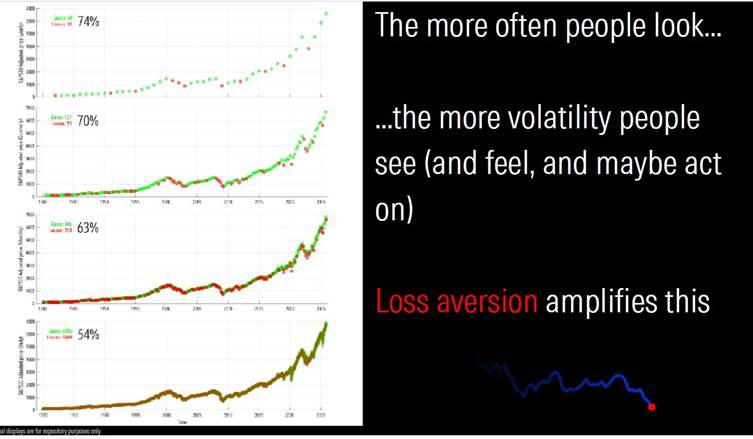
The same graph is divided into different periods, but the return in each graph is exactly the same. The only thing that differs is the frequency of observation. The top graph shows the investment journey of a person checking their returns annually. In this scenario, they experienced 34 periods of gains and 11 periods of losses, or gains 74% of the time against losses 26% of the time.
In the last graph, an investor checks their returns daily. In this scenario, they experienced 6,185 periods of gains and 5,560 periods of losses, or gains 54% of the time against losses 46% of the time.
Even though the journey led to the same destination, an investor with a high frequency of observations could have had a worse journey and been more tempted to act against what would have been in their best interests.
Why this matters: behaviour drives outcomes
This is where human psychology comes in.
Frequent exposure to short-term losses can trigger emotional responses — particularly loss aversion, where the pain of losses feels stronger than the satisfaction of gains. The result? Investors are more likely to:
- Panic during short-term declines
- Make reactive decisions
- Exit investments at the wrong time
Ironically, this behaviour can harm long-term returns far more than the volatility itself.
A better approach
Successful investing isn’t about eliminating volatility — it’s about managing your response to it.
That means:
- Setting realistic expectations upfront
- Understanding that downturns are normal and temporary
- Staying focused on long-term objectives rather than short-term noise
- Ensuring a properly diversified portfolio
Final thought
Volatility is not the enemy — it is the entry fee to long-term wealth creation.
The challenge is not to avoid it, but to stay disciplined through it.